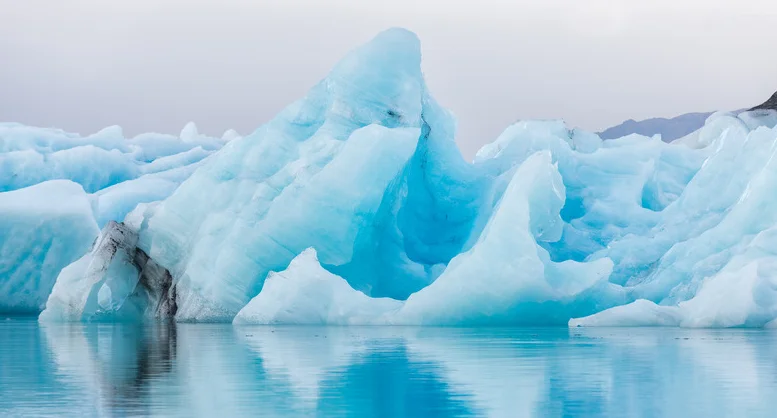
This is an account of the Greenhouse Equation, as described on page 49 in chapter 5 of A Farewell to Ice by Peter Wadhams. We are going to write down the equation, explain why it is important, and derive it from basic physical principles. Then we will experiment with it, to see what happens if the Earth has no atmosphere (as was the case in its earliest days), what happens if we melt the polar ice caps, etc. For the most part, these are harmless experiments. We do them with equations, mostly with pencil and paper. (Remember those?) However, there is a more dangerous experiment that we have been conducting for the last hundred years or so: pumping carbon dioxide into the air by burning fossil fuels. See Exercise 2 below and also Climate Change.
Here is the equation:
\[ T^4 = \frac{S(1-\alpha)}{4\,\epsilon \sigma}. \]
It computes \(T\), the average temperature of the Earth in terms of constants \(S\), \(\alpha\) and \(\epsilon\) which describe characteristics of the present-day Earth:
- \(S\), the solar irradiance at the Earth’s orbital distance. More precisely, \(S\) is the rate at which solar energy arrives per unit area on a surface perpendicular to the Sun’s rays at the mean Earth–Sun distance.
- \(\alpha\), the Earth’s albedo — It is a pure number between 0 and 1,
defined as the ratio between the average outgoing energy flux and average incomoming energy flux. If \(\alpha = 0\), the Earth absorbs all incoming sunlight (a perfectly black planet). If \(\alpha = 1\), the Earth reflects all incoming sunlight (no absorption at all, a “perfecly white” planet, or better, a perfect mirror). Typical values are
- Fresh snow: \(\alpha \approx 0.8–0.9\)..
- Ocean water: \(\alpha \approx 0.05–0.1\).
- Present-day Earth (global mean): \(\alpha \approx 0.3\).
- \(\epsilon\), the emissivity: a dimensionless number between 0 and 1 that measures how efficiently the Earth emits thermal (infrared) radiation compared with an ideal blackbody at the same temperature.
Some Conclusions
The equation tells us that without an atmosphere (emissivity = 1), the Earth would be very cold, with an average temperature of about minus 18 degrees Celsius. There would be no life. Happily, volcanic eruptions belch forth carbon dioxide, a gas which is opin the atmosphere traps a fraction of incoming solar radiation. This means that emissivity is less than one. The planet warms enough to sustain life. If man-made activities or other processes increase the concentration of carbon dioxide in the atmosphere, the average temperature of the Earth will increase. One effect is climate change: not only increased temperatures, but also increased intensity and frequency of storms, increased ocean temperatures, etc.
The Greenhouse Equation is not a precision instrument, but it is an excellent starting point for the analysis of climate change phenomena. The recognition of man-made climate change goes more than a century:
Svante Arrhenius (1859-1927) was a Swedish scientist that was the first to claim in 1896 that fossil fuel combustion may eventually result in enhanced global warming. He proposed a relation between atmospheric carbon dioxide concentrations and temperature. He found that the average surface temperature of the earth is about 15oC because of the infrared absorption capacity of water vapor and carbon dioxide. This is called the natural greenhouse effect. Arrhenius suggested a doubling of the CO2 concentration would lead to a 5oC temperature rise. He and Thomas Chamberlin calculated that human activities could warm the earth by adding carbon dioxide to the atmosphere. This research was a by-product of research of whether carbon dioxide would explain the causes of the great Ice Ages. This was not actually verified until 1987.
See Lenntech.com
Analysis
Incoming energy.
1. Absorbed solar power. The Earth intercepts sunlight over its cross-sectional disk of area \(\pi R^2\), not its full surface $4R^w. Here \(R\) is the radius of the Earth. The incoming solar power intercepted is
\[ P_{\text{in}} = S \cdot \pi R^2. \]
A fraction \(\alpha\) is reflected, so the absorbed fraction is
\[ P_{\text{abs}} = (1 - \alpha)P_{\text{in}} = S(1-\alpha)\,\pi R^2 . \]
2. Emitted solar power. To proceed, we assume that the Earth is black body. This is an idealized physical object that interacts with radiation in the simplest possible way. It absorbs all incident electromagnetic radiation, at all wavelengths and angles (no reflection, no transmission). It emits radiation with a spectrum that depends only on its temperature, not on its material composition. The very early Earth, which had no atmosphere was very close to a black body. A black body at temperature \(T\) emits thermal radiation with a flux (measured in watts per unit area) of
\[ j^* = \sigma T^4, \]
where \(\sigma\) is a physical constant with the value of \(5.67 \times 10^{-8}\) watts per square meter per degree K to the fourth power. (See Stefan-Boltzmann Law (DRAFT))
Here \(\sigma\) is a physical constant. To model an object like the present-day earth, we assume that the Earth emits some fraction \(\epsilon\) of that a black body would emit, so that
\[ j^*_{\text{Earth}} = \epsilon \sigma T^4, \]
The Earth emits over its whole surface area \(4\pi R^2\), so
\[ P_{\text{emit}} = (4\pi R^2)\,\epsilon \sigma T^4. \]
3. Radiative equilibrium
In the steady state, absorbed and emitted power are equal, so we ahve
\[ P_{\text{abs}} = P_{\text{emit}} \]
or in more detail,
\[ S(1-\alpha)\,\pi R^2 = 4\pi R^2\,\epsilon \sigma T^4. \]
Solving for \(T^4\), we find that
\[ T^4 = \frac{S(1-\alpha)}{4\,\epsilon \sigma}. \]
This is the “Greenhouse Equation.”
Let’s study the effect of changing emissivity, albedo, and other parameters.
Exercise 1: assume no atmosphere
As a first exercise, suppose that \(\alpha = 0.3\) and \(\epsilon = 1\). That is we take the albedo of the Earth to be about what it is now, with regions of land, sea, and ice, but we assume that the Earth has no atmosphere, and so acts as a black body. Solving for the temperature under these conditions yields
\[ T = 255\ K \]
This works out to about \(-18\) degrees C. The Earth without an atmosphere, with an emissitivy of 1, would be very cold – too cold to support life. Atmosphere is more than a medium in which birds fly and which supplies us with the oxygen that powers our cells.
Let’s continue playing with emissivity.
Exercise 2: Add \(\text{CO}_2\).
Adding \(\text{CO}_2\) to the atomosphere lowers the emissivity of the Earth. Why? Because \(\text{CO}_2\) molecules absorb infrared radiation, converting it into random molecular motion, i.e., heat. The energy of the infrared radiation that would normally be carried back into space is instead trapped in the atmosphere. Q.E.D. What is the effect? Since \(\epsilon\) appears in the denominator of the Greenhouse Equation, the equilibrium temperature rises as the emissivity decreases.
Exercise 3: Melt the north polar ice cap.
If we melt the north polar ice cap, we decrease the albedo of the Earth. That is, we decrease \(\alpha\), and therefore increase \(1 - \alpha\). Conclusion: the equilibrium temperature increases.
Exercise 4: Change the behavior of the sun.
The solar flux \(S\) is not constant: there is, for example, the well-known 11-year solar cycle, the “sun-spot cycle,” with an associated cycle in energy flux (see reference [3]). The relative increase in \(S\) from valley to peak is about 0.002, or 0.2%. However, because the cycle is a periodic — or almost periodic — phenomenon, its long-term effect is very small, likely zero: increases in solar flux in one half of the cycle are balanced by decreases in the other half.
Not well understood, though much discussed, are longer period cycles and long term drift in \(S\), if any. Good data is hard to come by: the best measurements are of recent origin, from space-based instruments. An interesting but speculative approach is to study sun-like stars.
Comments
We, the human race, have had an effect on emissivitiy by adding \(\text{CO}_2\) to the atmosphere. The resulting heating has reduced ice cover than therefore has indirectly reduced albedo. Human activity can affect emissivity and albedo, but not the solar flux.
Sadly, as we see with albedo, most of the climate feedback loops are positive, rather than negative. Negative feedback, of which a thermostat is an example, is a Good Thing. Systems with negative feedback are stable. Positive feedback is a Bad Thing in this context. Systems with positive feedback are unstable. Read runaway and imagine a mis-wired thermostat that increases the fuel fed to the furnace as the temperatue rises.
Note
The Kelvin scale of temperature is related to Centigrade by the equation \(T_C = T_K - 273.16\). That is water freezes at 273.16 degrees K. Seems like an odd scale. But: absolute zero, or 0 degrees K, is the temperature at which all molecular motion ceases (well, up to a small quantum effect). Absolutel zero is also the temperature at which an ideal gas occupies zero volume. Ideal gases do not exist. They would violate the Heisenberg’s uncertainty principle.
References
A Farewell to Ice, by Peter Wadhams
Solar Cycle Varation in Solar Irradiance, by K.L. Yeo·N.A. Krivova·S.K. Solanki.